

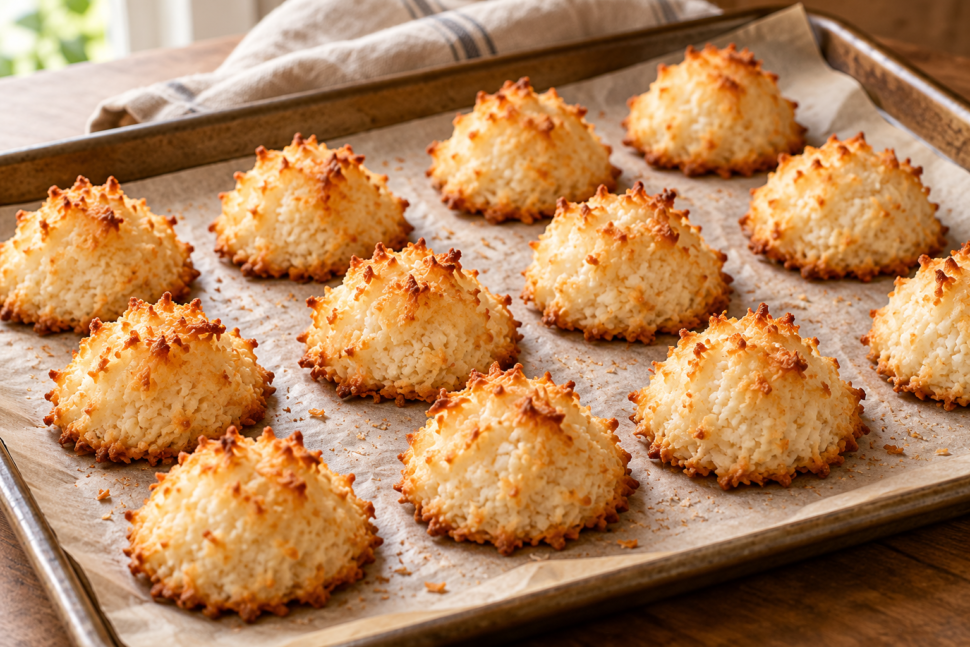
Bake chewy coconut macaroons with golden edges using egg whites and unsweetened coconut. Includes shaping advice and help for mixtures that spread.
These small coconut macaroons have a lightly toasted outside and a chewy centre. They are the rustic coconut cookies, not the smooth almond sandwich biscuits called macarons. Egg whites bind the shredded coconut, while a short standing time lets the mixture absorb moisture before shaping. There is no condensed milk or chocolate coating in this version. Keep the mounds small and consistent so their centres can bake through before their edges get too dark.
Makes: 18 small macaroons. Estimated timing: 15 minutes preparation, around 20–25 minutes baking and 15 minutes cooling; allow roughly 55 minutes overall.
Jump to ingredients · Jump to instructions
Recipe development note: this recipe has not been kitchen-tested by Tasty Food. Times are estimates; follow the texture and doneness cues. The featured image is an AI-generated serving illustration and may differ from your result.
Equipment
Kitchen scales, mixing bowl, hand whisk, spoon, lined baking tray, thin spatula and cooling rack.
TASTY FOOD / RECIPE CARD
Coconut Macaroons with Golden Edges
Times are estimates. Follow the method’s doneness cues. Tick ingredients as you prepare.
Makes: 18 small macaroons. Estimated timing: 15 minutes preparation, around 20–25 minutes baking and 15 minutes cooling; allow roughly 55 minutes overall.
Recipe development note: this recipe has not been kitchen-tested by Tasty Food. Times are estimates; follow the texture and doneness cues. The featured image is an AI-generated serving illustration and may differ from your result.
Equipment
Kitchen scales, mixing bowl, hand whisk, spoon, lined baking tray, thin spatula and cooling rack.
Ingredients
- 180 g unsweetened finely shredded or desiccated coconut
- 90 g caster or fine granulated sugar
- 2 large egg whites, about 60 g total
- 1 teaspoon vanilla extract
- 1/8 teaspoon fine salt
Instructions
- Prepare the tray. Heat the oven to 170°C/150°C fan/340°F. Line a large flat baking tray with baking parchment. If using two trays, plan to rotate them during baking. Check that the coconut is unsweetened and relatively fine; long thick flakes will not bind as neatly without further chopping.
- Whisk the whites lightly. Put egg whites, sugar, vanilla and salt in a clean bowl. Whisk by hand for about 1 minute until the sugar is moistened and the mixture looks foamy. Do not whisk to stiff peaks: this is a coconut mixture, not a meringue shell. Keep raw egg away from ready-to-eat ingredients.
- Hydrate the coconut. Stir in all the coconut until no dry pockets remain. Let stand for 5 minutes, then squeeze a small spoonful gently. It should hold together as a damp clump rather than drip. If unusually dry and crumbly, mix in 1 teaspoon water at a time, using only enough to bring it together.
- Shape compact mounds. Divide into 18 portions, around 18 g each. With lightly dampened fingertips, press each portion into a compact rounded mound about 3 cm across. Set on the lined tray with a few centimetres between them. Gather any loose shreds back onto the mounds so they do not burn separately.
- Bake until set. Bake for about 20–25 minutes, rotating the tray if the oven browns unevenly. Look for golden tips and edges, lightly coloured bases and centres that feel set rather than wet when gently touched. Reduce the heat slightly and continue briefly if the outside colours too quickly. Do not leave the middle as raw egg mixture.
- Cool before moving. Leave on the tray for about 10 minutes, then carefully lift with a thin spatula to a rack and cool for another 5 minutes or longer. Hot macaroons are fragile and can stick or break if lifted immediately. Serve once cool enough to hold, or let cool completely before packing.
Tips and troubleshooting
Macaroons that spread into flat puddles have too much liquid or too little coconut for the egg-white size. Weigh the whites rather than using two very large ones. If the mixture sheds dry coconut before baking, let it stand a little longer and compact it more firmly. Finely desiccated coconut may need a touch more water than shredded coconut. Aim for a moist clump, never a pourable batter.
Substitutions and serving ideas
For a citrus version, add the finely grated zest of half a washed orange along with the vanilla. For chocolate-dipped macaroons, dip only fully cooled bases into melted chocolate and let set; this introduces whichever allergens the chocolate contains. Sweetened coconut is not a direct replacement because it changes both sweetness and moisture. An egg-free variation needs a different binder and has not been tested here.
Allergen notes
Contains egg and coconut. Coconut is not interchangeable with tree nuts in allergy advice; individual requirements vary. Check the coconut package and vanilla for cross-contact information. Any optional chocolate may add milk or soy. No wheat flour is added, but certified ingredients are needed if gluten avoidance matters.
Storage
Once completely cool, keep in an airtight container in a cool room for up to 3 days, or refrigerate in hot weather. Freeze in a sealed container for best quality within 1 month, separating layers with parchment. Defrost covered in the refrigerator. Their crisp edges soften over time; this is a texture change, not a reason to keep them beyond normal storage limits.
Original recipe and updates: https://tastyfood.fun/2026/10/28/coconut-macaroons/
More dessert ideas
Next, try Fudgy Chocolate Brownies with Crackly Tops, or browse the complete recipe index. For questions or recipe corrections, visit our contact page.